
What Is Hydrocephalus?
Hydrocephalus, a brain disorder, is the name of the disease caused by the problem of fluid accumulation inside and around the brain. The fluid in question occurs as a result of excessive accumulation of cerebrospinal fluid. This condition may appear from the first days of birth or develop over time. As a result of excessive accumulation of this fluid and its inability to be absorbed, deformity in the shape of the head may occur, and brain functions may also be adversely affected.
Cerebrospinal fluid is continuously produced and helps increase the brain’s protection against impacts, provides circulation, and also balances brain pressure. According to studies, this condition is seen in one out of every 600 children born. In adults, individuals over the age of 60 generally face this problem.
Causes of Hydrocephalus
Different and independent causes may affect the circulation of fluid in the brain. The cause of the increase in cerebrospinal fluid is generally examined in two main groups. The first is obstruction in the chamber where the fluid circulates; the second is the loss of function of the arachnoid membrane, which is responsible for absorbing this continuously produced fluid.
Hydrocephalus caused by obstruction is among the most common cases. The blockage that forms somewhere and stops the circulation of cerebrospinal fluid may prevent the fluid from being absorbed by the arachnoid membrane and, as a result, may cause the water level to rise. Thus, the fluid accumulates and increases, thereby putting pressure on the brain and causing damage to brain tissue. The obstruction may occur for various reasons. Even a brain tumor located in that area may block the flow of fluid and cause obstruction.

Hydrocephalus caused by absorption disorder is especially seen in newborns when the arachnoid membrane tissue has not developed sufficiently and cannot fully perform its function. Other causes include inflammation of the brain membrane (meningitis) and bleeding between the brain and the membrane. These bleedings usually occur as a result of head injuries. The causes of hydrocephalus can be explained in this way.
What Are the Causes of Hydrocephalus?
- Intracranial hemorrhages,
- Head traumas,
- Brain tumors,
- Bleeding related to premature birth
- Meningitis
- Congenital anomalies (meningomyelocele
What Are the Symptoms of Hydrocephalus?
The most important symptom of hydrocephalus seen at an early age is deformity and excessive enlargement of the head. Since the skull bones fuse and harden between the ages of 6 and 10, this is the most important symptom of hydrocephalus occurring at a young age. However, this is not the only symptom. At the same time, enlargement seen in a child patient’s head may not always be caused by hydrocephalus. If the cause of the enlargement in the head is hydrocephalus, the head will grow very rapidly, the forehead will protrude forward and appear flat, and the eyes will appear pushed downward. The upper part of the white-colored part of the eye may also be clearly visible. (This sign is referred to in medical literature as the sunset sign.) If hydrocephalus develops very rapidly and the enlargement of the head progresses quickly, severe pressure of the fluid on the brain may result in intellectual disability, muscle stiffness, and paralysis. In cases that occur after the skull bones have fused, there is no head enlargement problem, and in this respect the symptoms are more commonly seen as vomiting, severe headaches, balance disorders, progressively increasing impairment in mental abilities and related dementia, irritability, and memory loss over time. As can be seen, symptoms of hydrocephalus appear differently in babies, children, and adults.
If not treated in time, as the amount of fluid in the brain increases and the pressure rises accordingly, the patient experiences difficulty walking and has trouble maintaining balance. The retinal layer located behind the eye begins to swell. If the disease develops rapidly in older adults, dementia, urinary incontinence, and similar conditions may appear in a short time.
How Is Hydrocephalus Treated?
Treatment of hydrocephalus with medication is not possible. Hydrocephalus can only be corrected through surgical interventions performed by brain and neurosurgery specialists.
The type of surgical intervention to be chosen will vary depending on the underlying cause of hydrocephalus.??If there is an obstruction causing disruption of the circulation of cerebrospinal fluid, surgical treatment may be performed for the obstruction causing it (tumor, cyst, etc.). If the obstruction cannot be opened, the intracerebral circulation pathways of cerebrospinal fluid may be altered through surgical interventions.
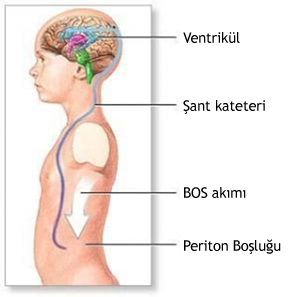
Since it is not possible in most patients to restore the circulation of cerebrospinal fluid to its previous state, the fluid must be transferred from the brain to another body cavity. For this transfer, a thin, long, elastic silicone tube called a "shunt" is used. In order for the system to function in a one-way and controlled manner, there is a part of the system called the "pump" under the scalp. The excess cerebrospinal fluid is carried to another part of the body through this thin tube. Thus, the increase in pressure inside the brain is prevented. However, since fluid is produced continuously in the brain, this system must work continuously.
The disease is diagnosed by taking a brain tomography scan of the patient. The fluid-filled spaces are monitored in a computer environment. Hydrocephalus caused by obstruction due to tumors and cysts can be clearly seen in this way. In addition to tomography, an X-ray image is taken with the help of special injections to try to determine the direction of fluid flow in the brain. In this way, it can be determined that hydrocephalus has occurred due to a problem in the arachnoid membrane and therefore due to fluid absorption failure.
Many cases are treated with surgery. Therefore, the question of how hydrocephalus is treated may bring different answers. For example, narrowing in the fluid channels and obstruction occurring in the fourth ventricle are treated by draining the fluid with the help of a tube placed into the basal brain space and the ventricles. In another method that may be applied in other cases, the fluid in the ventricles is drained by connecting it to a blood vessel or to the peritoneal cavity in the abdomen. In this procedure, referred to as shunt surgery, a type of valve is used so that the fluid does not flow in a different direction. With the help of a small hole opened in the skull, a tube is connected from the ventricles to the abdominal area or the jugular vein in the neck. These tubes are called shunts and remain attached to the patient for life after the procedure. In this way, the fluid absorption function that the arachnoid membrane tissue cannot perform is achieved and the disease can be stopped.
At What Ages Is Hydrocephalus More Common?
Hydrocephalus can be seen at any age, but it is frequently seen in children and in older adults (over 60 years of age).
How Is Hydrocephalus Diagnosed?
- Brain Tomography,
- Magnetic Resonance Imaging,
- Brain Ultrasonography (during the newborn period)
Frequently Asked Questions About Hydrocephalus
What does hydrocephalus mean?
Hydrocephalus is a disease that occurs as a result of excessive fluid accumulation in and around the brain. The name hydrocephalus is derived from Latin words meaning water and head.
What causes hydrocephalus?
Hydrocephalus occurs as a result of disruption in the normal circulation of cerebrospinal fluid (CSF). For this reason, hydrocephalus may develop due to various factors. Causes may include congenital anomalies, infections such as meningitis, brain hemorrhages, tumors, and other reasons affecting the absorption of cerebrospinal fluid. Hydrocephalus may also be seen in older adults, and sometimes the cause may be unknown (idiopathic).
Who gets hydrocephalus?
Hydrocephalus may occur at any age and may develop due to various causes. These may include congenital anomalies, infections, brain hemorrhages, tumors, and trauma. Hydrocephalus may also occur in older adults.
What are the symptoms of hydrocephalus in babies?
Symptoms of hydrocephalus in babies may be seen as follows:
Rapid growth of head circumference
Swelling of the soft spots on the baby’s head called fontanelles
A downward gaze in the eyes, known as the "sunsetting eyes"
Headache
Loss of appetite and irritability
Vomiting
Loss of balance or walking problems
Changes in sleep pattern
What are the symptoms of hydrocephalus in adults?
Symptoms of hydrocephalus in adults may be listed as follows:
Headache
Nausea and vomiting
Fatigue and weakness
Loss of balance and difficulty with coordination
Memory problems and forgetfulness
Difficulty walking and loss of balance
Urinary incontinence or urgency
Visual disturbance or double vision
Reduced hearing
Numbness or tingling sensation
At what ages is hydrocephalus common?
Hydrocephalus can be seen at any age, but it is more common in children and in older adults (over 60 years of age).
Can hydrocephalus go away?
Hydrocephalus is usually treated with surgical intervention. If left untreated, it may cause serious brain damage and even death. After surgical intervention, the symptoms of hydrocephalus improve rapidly and long-term effects are generally absent. However, in some cases, hydrocephalus may recur and long-term follow-up may be required.
Is drug treatment possible for hydrocephalus?
Drug treatment for hydrocephalus is not possible. Hydrocephalus can only be corrected through surgical interventions performed by brain and neurosurgery specialists.