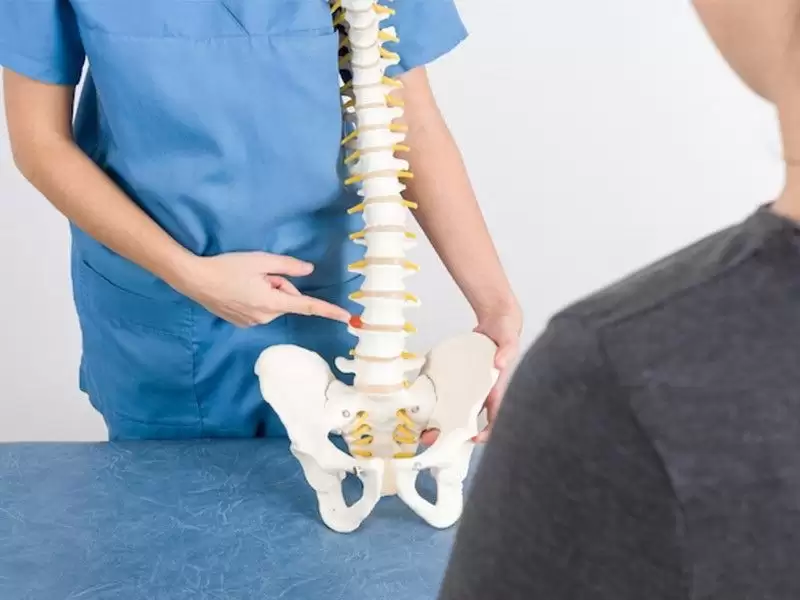
When the nucleus pulposus, which has degenerated and lost its elasticity, protrudes through a tear in the annulus fibrosus due to any strain or improper movement, or when the nucleus pulposus together with the annulus fibrosus sags from the disc space toward the spinal canal, the condition we call a herniated disc or disc herniation develops. As a result of one of the nerve roots being compressed and remaining under pressure, complaints such as numbness, tingling, pain, and weakness in the legs and/or feet may occur.
What Findings Occur Depending on the Level of the Herniated Disc?
- In L3 -4 Discs : The affected root is the L4 root, and pain or sensory loss is felt on the front of the thigh and the inner side of the leg.
- In L4 -5 Discs : The affected root is the L5 root. Pain is felt in the hip, the outer side of the leg, the top of the foot, and the big toe; numbness is felt on the outer side of the leg and in the big toe. Weakness may develop in lifting the big toe and the foot upward.
- In L5 -S1 Discs : Pain is felt in the hip, the back of the thigh and leg, the heel, and the outer lower part of the foot; sensory loss occurs on the back outer side of the leg and the outer part of the foot. A decrease or loss of strength in pushing the foot downward may develop.
At Which Levels Is a Herniated Disc Most Commonly Seen?
Herniated disc is most commonly seen at the L4 - 5 and L5 - S1 levels.

Accordingly, the L5 or S1 roots come under pressure. Since both roots form the sciatic nerve, pain occurs in the area corresponding to the compressed root on the side where the herniation is present. Along with nerve root compression, the muscles located next to the spine in the back contract reflexively and go into spasm. Although this is actually a protective mechanism of the body, pain in the lower back that increases with movement occurs because of the spasm. Scoliosis may even develop in the spine due to muscle spasm. (Antalgic posture)
When Is Emergency Surgery Necessary in Herniated Discs?
In cauda syndrome, the disc material ( nucleus pulposus ) enters the spinal canal and compresses the nerve fibers coming out of the spinal cord. As a result of this pressure on the nerve fibers, a very severe condition occurs, characterized by saddle-type sensory loss ( numbness ), weakness in the legs that may progress to paraplegia ( paralysis of both legs ), urinary and fecal incontinence, and loss of sexual function. In cauda syndrome, the patient may previously have had complaints of low back pain and sciatica-like symptoms, but this condition may also occur without them. In cauda syndrome, severe neurological symptoms develop suddenly, and if intervention is not performed urgently, the patient has a high probability of becoming paraplegic. In delayed intervention, the chance of recovery of the developed findings ( paralysis in the legs and loss of urinary - fecal control ) is low. In patients who develop foot drop, the patient cannot lift the foot upward from the ankle and walks by dragging the foot. Herniated discs that cause cauda syndrome and foot drop must be operated on urgently.
Why Am I Having Surgery on My Lower Back Even Though I Have Leg Pain?
Many patients hesitate about why they are having surgery on their lower back even though the pain is in their leg. The sciatic nerve is the thickest nerve in the human body. Fibers coming from the L4, L5, S1, and S2 roots contribute to the structure of this nerve. The sciatic nerve has motor fibers that provide movement and strength to the leg, and sensory fibers that provide sensation. As a result of compression in any of these roots, sensations such as pain and numbness are carried by the sensory fibers to the related area, so the patient feels the pain in the area where the nerve spreads. Because pain in herniated disc cases is felt along the sciatic nerve, the term sciatica used among the public has the same meaning as herniated disc.