
Endoscopic Pituitary Surgery
The pituitary gland tumor, which is the most commonly encountered tumor within the skull, is the tissue located behind the optic nerves and prevents the pituitary gland from functioning properly. As is known, the pituitary gland is the tissue that determines the amount and timing of the secretion of certain hormones that need to be released in the body. Pituitary gland tumor can be treated in different ways depending on its size and the effect it creates. The treatment of the pituitary gland tumor decided to be operated on can be performed with different surgical operations.
Pituitary gland tumor is divided into two types as “secreting” and “non-secreting.” The treatment process is also shaped according to this difference.
Symptoms Of Pituitary Gland Tumor
In the early stages of the disease, symptoms may not appear suddenly. Therefore, diagnosis may take time, and different disorders may appear as a result of some complications that emerge over time. Let us mention some symptoms that may occur.
Headache: The tumor forming on the pituitary gland may cause headache, and this pain may be located at the back of the patient’s head and may sometimes be severe compared to other headaches. The pain initiated by the tumor seen in the pituitary gland located in the posterior part of the brain may even be felt from the inner parts of the nose.
Problems in vision: The optic nerves are located in front of the pituitary gland, and the tumor that forms and grows on the gland causes pressure on this area over time, leading to visual disturbances.
Irregular menstruation: The tumor, which causes the pituitary gland to secrete excessively or insufficiently, may accordingly lead to menstrual irregularities. The irregularity in menstruation will return to its previous order as a result of the treatment of the pituitary gland tumor.
Sexual impotence: Pituitary gland tumor, which affects hormonal disorders, may lead to sexual impotence in male patients.
Sudden changes in mood: Since the tumor increasing its pressure on the pituitary gland causes hormonal imbalance, the patient exhibits mood changes ranging from sudden irritability to laughing fits.
Infertility: Cases of infertility that may occur because of pituitary gland tumor may improve after treatment. However, this condition may sometimes remain permanent.
Changes in the amount of breast milk: The pituitary gland, which plays an important role in the secretion of the prolactin hormone, may sometimes secrete too much and sometimes too little because of the tumor developing there, and accordingly there is a change in the amount of breast milk.
Cushing syndrome caused by excessively secreted ACTH: Excessively secreted ACTH hormone causes excessive weight gain, the formation of fragile bone structure, skin marks, and emotional changes, and leads to the triggering of Cushing syndrome.
Excessive growth or delayed growth: Excess growth hormone seen in the pituitary gland due to the disease causes children to grow taller than normal, while insufficient secretion causes delayed growth.
Fatigue and impatience: The irregularity in hormones causes problems such as fatigue, irritability, and inability to be patient.
Endoscopic Pituitary Surgery Process
After the endoscopic method is determined for pituitary gland tumor surgery, the patient needs to be prepared for the operation. Before the surgery, which will be started through the nose, the patient should undergo sinus and nasal examination. If there is an infection in the patient’s sinuses, if there is a problem with smelling, if postnasal drip has developed, and if there are also symptoms such as headache, treatment should first be applied to resolve these problems. In addition, before endoscopic pituitary tumor surgery, many tests should be performed on patients along with neurological and physical examination. The patient is informed in detail by explaining the answer to the question of how endoscopic pituitary tumor surgery is performed.
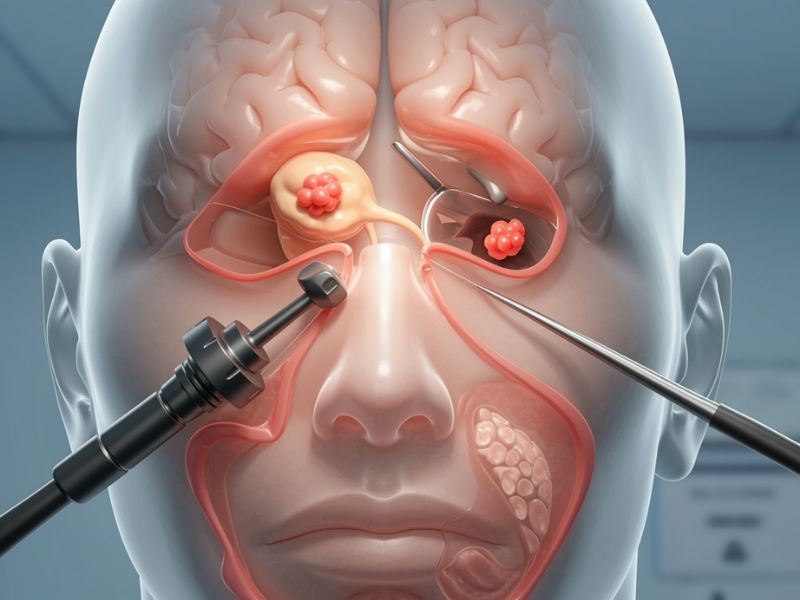
In endoscopic pituitary surgery, which is an operation jointly carried out by the ENT specialist and neurosurgery, technological systems called endoscopes and navigation are used. The ENT specialist, as the surgeon who starts the surgery first, enters through the sinus with an endoscope and reaches the pituitary gland located in the posterior part of the brain. After this point, the neurosurgeon completes the operation by completely cleaning the tumor. After the procedure, in some cases there is no need to place a tampon inside the nose. The tissue damaged inside can be repaired with different methods. Afterwards, the patient is discharged in a short time and enters a rapid recovery process, returning to normal life.
Is Endoscopic Pituitary Surgery Risky?
Of course, there are some risks in every surgical intervention. There is risk in every operation, but this rate varies depending on the method used in the surgery and the surgeon’s experience. Some risks may be life-threatening, while others can be corrected with treatment. The most important thing to know about endoscopic pituitary tumor surgery is that some complications that developed before treatment due to the pressure exerted on the pituitary gland may not be resolved 100% after treatment. For example, if excessive pressure on the optic nerves has caused damage to the nerves, permanent blindness may occur. The pituitary gland may be damaged during surgery. Meningitis may develop. During the operation, cerebrospinal fluid may leak out through holes that may form in the lining of the skull. Adhesion may occur in the tissues within the sinus, causing blockage. Deformation may occur in the nose. Later, this condition can be corrected with surgery. Nosebleeds may occur, and in a very small number of patients this bleeding may continue for a long time after the surgery.