
“The maddening disease”, “The driving-you-crazy disease”, “The worst pain in the world” are names used for trigeminal neuralgia, which causes an extremely distressing condition for the patient because of the pain it creates.
Trigeminal neuralgia is a neurological disease and a chronic pain disorder that causes severe and sudden pain in the face due to pressure occurring near the point where the trigeminal nerve enters the brainstem.
Although it can be seen at any age, it usually occurs after the age of 50. It is seen more frequently in women than in men. It is also thought to have a genetic (familial) origin.
In trigeminal neuralgia cases, sudden, severe, electric shock-like pain attacks are experienced on one side of the face. These pain attacks are the most distinctive symptom of trigeminal neuralgia. These pain attacks also create a sensation of soreness, stinging, and burning. Although the duration of the pain attacks varies from a few seconds to a few minutes, the frequency of these attacks also varies from patient to patient.
What Are the Causes of Trigeminal Neuralgia?
The trigeminal nerve is present as 2 nerves on the right and left, and after emerging from the area called the brainstem, it divides into three branches above the ear and spreads across the face.
- The first branch provides sensation to the upper eyelid and forehead
- The second branch provides sensation to the lower eyelid, upper jaw, nose and nostril, and cheek area
- The third branch provides sensation to the lower jaw and inner part and the function of some muscles related to chewing.
With the involvement of usually one and sometimes more of these branches, it manifests itself with severe pain most commonly in the lower jaw region, then in the upper cheek and eye region.
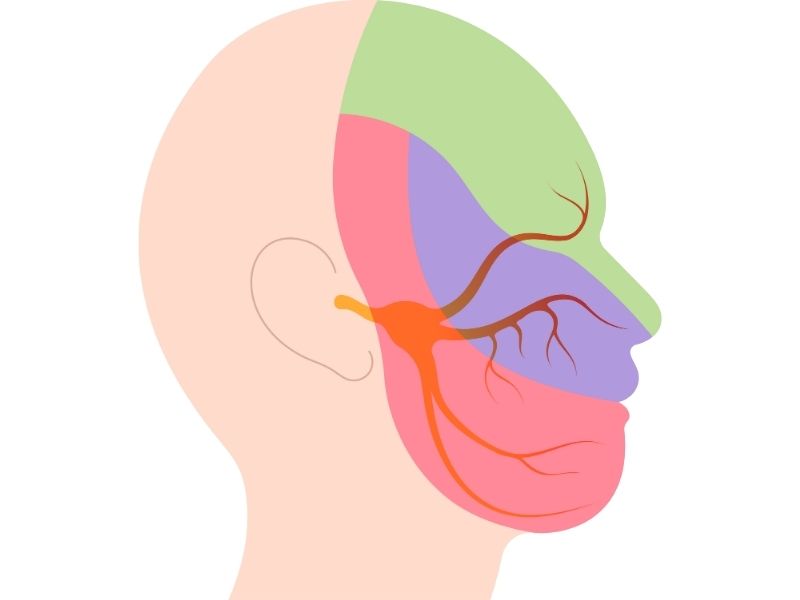
Involvement of two separate branches together can also be seen, but involvement of all three branches is very rare. The most common cause of trigeminal neuralgia is compression of the trigeminal nerve (also called the fifth cranial nerve ) by an artery or veins at the base of the brain.
As a result of the contact of these branches with arteries or veins, the myelin sheath, which is a special covering that helps the nerve transmit signals more rapidly, wears away and the nerve begins to send abnormal pain signals. In addition to vascular problems, tumoral formations pressing on the nerve and a similar condition that damages the myelin sheath protecting the nerves in diseases such as multiple sclerosis can also cause trigeminal neuralgia. In addition, a tumor that causes pressure on the trigeminal nerve may also lead to trigeminal neuralgia.
What Are the Symptoms of Trigeminal Neuralgia?
Severe, stabbing, or throbbing pain attacks in the face resembling an electric shock are the most common symptom of trigeminal neuralgia. These pains are sudden pain attacks triggered by touching the face, chewing, talking, or brushing the teeth. Stinging, burning, soreness, and facial spasms are also among the symptoms along with the pain.
A symptom of trigeminal neuralgia is generally a sudden and severe electric shock-like pain felt on one side of the face and lasting a few seconds. After this type of pain, which is counted among the symptoms of trigeminal neuralgia, throbbing that spreads over minutes may be felt.
- Electric shock-like pain attacks on one side of the face
- Sudden pain attacks triggered by touching the face, chewing, talking, or brushing the teeth
- Pain occurring together with facial spasms
- Tingling and numbness in one area of the face
These pain attacks can occur without any stimulus, as well as with;
- Light touch
- Eating
- Brushing teeth
- Shaving or applying makeup
- They may even occur with the blowing of the wind.
How Is Trigeminal Neuralgia Diagnosed?
Many diseases such as migraine, tension headache, and temporomandibular joint disorder can cause one-sided facial pain. Distinguishing trigeminal neuralgia from other causes of facial and head pain is done by evaluating the patient's complaints and symptoms during examination by a specialist doctor. The diagnosis can be confirmed by MRI imaging directed at the trigeminal nerve. In these specialized MRI studies, vascular formations compressing the trigeminal nerve can be visualized.
How Is Trigeminal Neuralgia Treated?
In trigeminal neuralgia, drug treatment is first administered to relieve the pain. The effective drugs are medications used in the treatment of epilepsy. The pain of many patients is calmed by these drugs. If the patient feels relief with drug treatment, these drugs can be used for life. However, although the drugs are paused during the periods when trigeminal neuralgia pain attacks subside, they are used again when the attacks begin.
The drugs used include anticonvulsants and tricyclic antidepressants.

Anticonvulsants inhibit nerve activity to control pain. However, these drugs may have various disturbing side effects (for example, mental confusion, drowsiness, and nausea). During the first few weeks of carbamazepine use, your blood count and blood sodium should be monitored carefully.
Over time, in many patients the effectiveness of the medication gradually decreases and severe pain occurs despite the drug. This is where the need for surgical treatment comes into play. Surgical treatment options include microvascular decompression, balloon compression by foramen ovale puncture, radiofrequency, or alcohol applications.
Trigeminal Neuralgia Surgery
Microvascular decompression should primarily be preferred especially in young patients and in patients in whom radiological vascular compression of the trigeminal nerve has been demonstrated. With the surgery performed, a pain-free life for a lifetime is possible. In this method, the trigeminal nerve is exposed with microsurgical technique and the vascular structures compressing the nerve are moved away from the nerve with a special material, and in this way a lifelong pain-free period can be obtained in almost all cases.
As with all surgical procedures, there are complications that may be encountered in these surgeries, and patients may rarely (less than 5% of patients) experience facial weakness, numbness, double vision, or decreased hearing.
If during the microvascular decompression procedure the surgeon cannot find a blood vessel compressing the nerve (10% - 20% of patients), it may be necessary to cut a part of the nerve. If this is done, the patient's facial pain will most likely be relieved, but they will experience permanent numbness in the area of the face where the pain was located.
Trigeminal Neuralgia Balloon Compression Treatment
Under general anesthesia, an entry is made with a needle through the cheek to the point where the trigeminal nerve exits the face. With the help of the needle, a small balloon is passed through and this balloon is inflated to press the nerve against the skull bone. After about 1 to 2 minutes, the balloon is deflated and removed. Although the inflated balloon does not cause permanent damage to the nerve, it creates myelin loss in the fibers of the nerve that cause pain, thereby enabling the pain to disappear.
Although the risk of recurrence of the disease is not as low as that of microvascular decompression surgery, it is a very effective treatment method with few complications. Being a repeatable method allows it to be applied again if the disease recurs.